VIBE
BASKETBALL
One night court, two complete modes. Play the original contact-heavy 1v1, or run a four-shooter 3-Point Contest with 1–4 local players, live CPU rounds, elimination, and shoot-offs.
Take the court live production build · 2 modes · desktop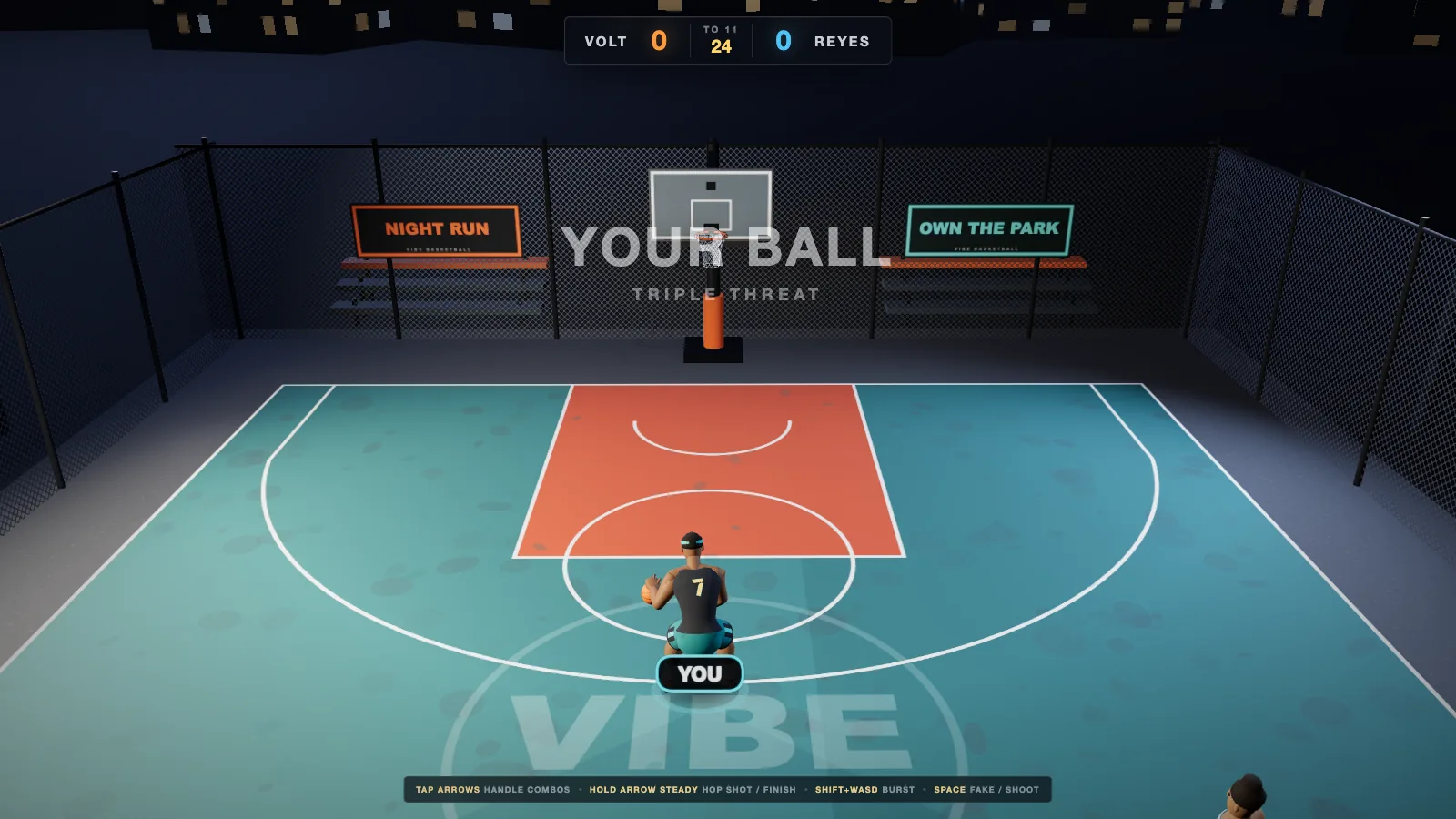
Click the court once to give it focus, then choose 1V1 STREET, 3-POINT CONTEST, or HOW TO PLAY. Fullscreen is recommended.
MENU: W/S or D-pad select · ENTER/A confirm · 1V1: WASD move · SHIFT sprint · CTRL body · ARROWS skill stick · SPACE shoot · 3PT: choose players and money rack, then hold/release SPACE · ENTER/A skips CPU
Tap is a handle.
Hold is a decision.
The arrow keys are a separate skill stick, not a second set of movement keys. Tap away from the receiving hand for a crossover, tap toward it for a same-hand side drive, tap up for between-the-legs, or tap down for behind-the-back. A new direction takes over immediately, so rolling inputs create a live sequence instead of filling an animation queue.
Hold one direction for about 230 milliseconds and the same control commits to a finish: side-hop or step-back jumpers outside, then hand-specific layups, a floater, or directional dunks on the drive. WASD remains locomotion throughout, so the player can burst out of a move without surrendering the line to the rim.
One body key.
Both sides of the ball.
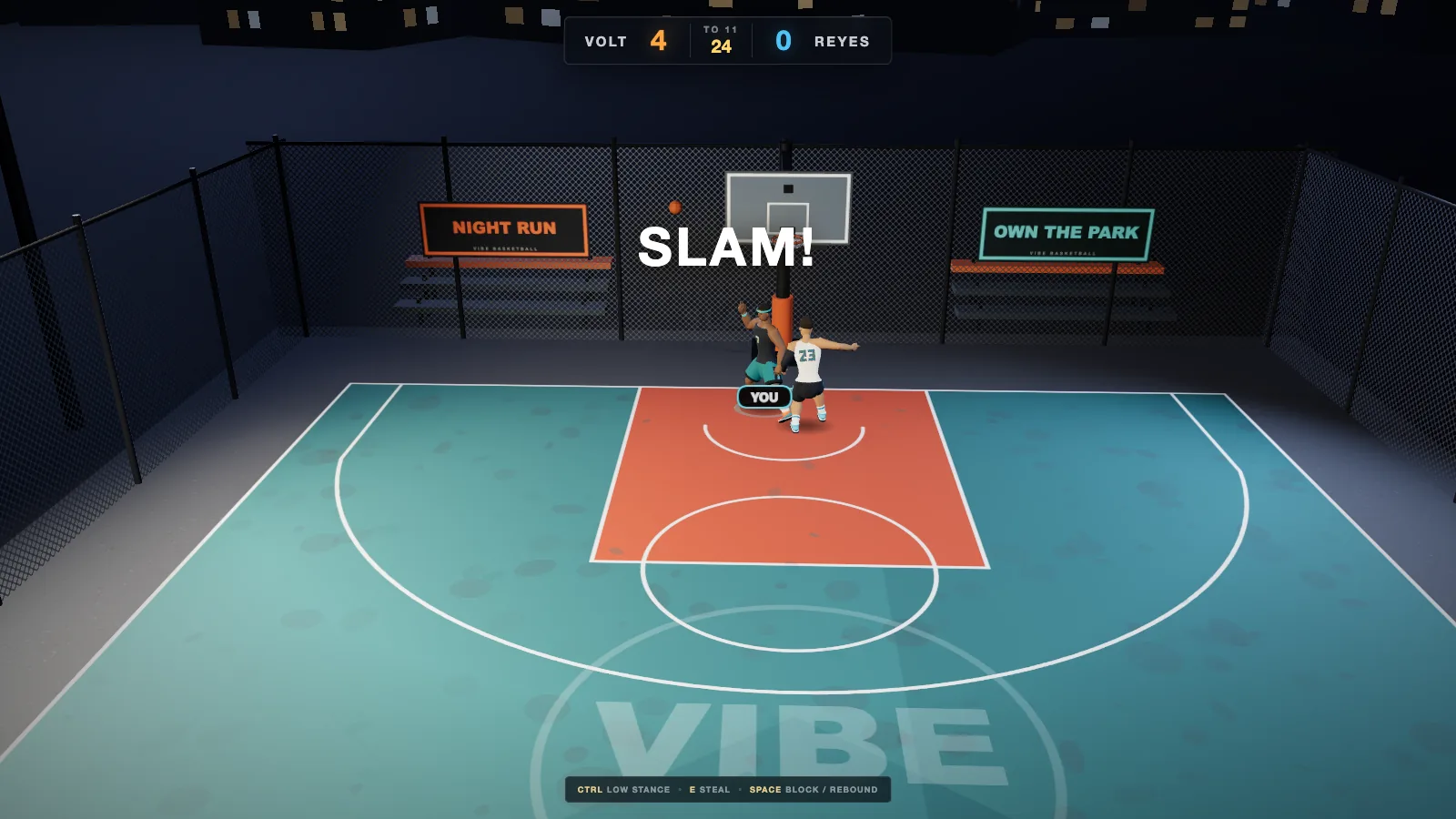
CTRL carries one meaning: commit the body. With the ball it protects the dribble and, with a defender on the back near the paint, becomes a stamina-driven post-up. On defense it drops into a low stance; while the ball is in the air and inside position is won, it seals the rebound lane with a box-out.
The rest of the contact game follows the same rule. Steals need an exposed ball, blocks have front and chase windows, and rebounds require real current-frame or swept palm-to-ball contact. A block still has to win before release; once the ball leaves the hand and the game shows PERFECT, that displayed make is locked and a late contest cannot rewrite it.
Four shooters.
Every ball matters.
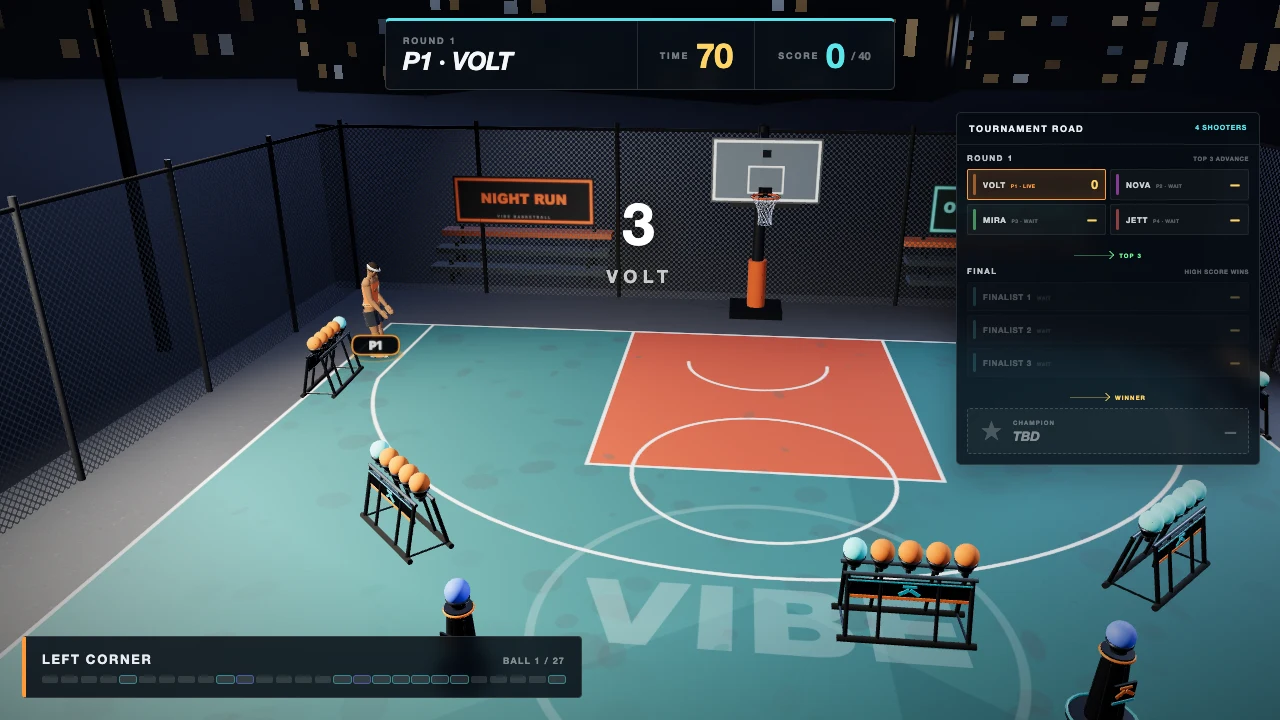
Choose one to four local players; the four fixed cards become P1 through P4 in order, with any remaining slots controlled by CPU. Each local player chooses a money rack only when their turn arrives. The game handles the run between seven stations, while the player keeps the same familiar hold-and-release jumper.
Every round is 27 balls in 70 seconds: five racks, one chosen all-money rack, two deep three-point balls, and a 40-point ceiling. The top three advance to a reverse-order Final. Qualification ties use repeated 30-second shoot-offs; a tied championship repeats the full 70-second round. CPU plans are seed-locked, so watching, skipping immediately, or skipping halfway produces the same score.
Two modes.
One shooting contract.
The original match remains 1v1 to 11, win by two with a cap at 15: make-it-take-it, a 24-second clock, check balls, out of bounds, and take-back after a defensive board. The new contest reuses that shot meter and outcome contract, then adds multi-ball flight, 27-ball rack state, deterministic CPU simulation, and a full tournament roadmap without changing the street game.
- Immediate crossover, double-cross, side drive, between-the-legs, behind-the-back, spin, and burst exits
- Directional side-hop, forward-hop, step-back, layup, floater, and left/right dunk branches
- A readable release meter with a broad stable band and a narrow deterministic PERFECT window
- Five racks, selectable money rack, two deep balls, eight reusable live balls, and late-ball settlement
- Four fixed entrants, 1–4 local players, watch/skip CPU, top-three Final, shoot-offs, and champion road